
The rent may look great on paper. But what does your property actually keep after the real costs of ownership?
You can collect the rent on time, cover the mortgage, and still wonder where the cash went. That is because insurance, taxes, vacancies, repairs, utilities, and future replacements are all competing for the same income.
So instead of asking, “Does the rent cover the mortgage?” ask this: “What does the property keep after the full cost of running and maintaining it?”
Start With Costs That Never Take a Month Off
Start with the bills that show up whether the property is full or empty: property taxes, insurance, owner-paid utilities, landscaping, pest control, accounting, management, and association dues, if any. Turn annual bills into monthly amounts, and check whether taxes and insurance are already included in your mortgage escrow, so you do not count them twice.
Buying a property? Do not assume the seller’s tax bill will become yours. The Pinellas County Property Appraiser recommends estimating taxes after a change in ownership before you lock in your budget.
Your Insurance Premium Is Only Part of the Story
In Florida, the annual premium is only the beginning of the insurance conversation. What does the policy cover or exclude? How does it handle wind, flood, loss of rent, and deductibles? If you own a multifamily property, make sure you also understand how coverage applies across the buildings.
Here is one deductible detail that can catch owners by surprise: Florida’s Department of Financial Services notes that hurricane deductibles may be based on a percentage of the insured value. A 2% deductible on an applicable insured value of $1 million is $20,000—not 2% of the repair bill. Every policy is different, so review the actual terms with an insurance professional.
A Small Leak Can Take a Big Bite Out of Your Cash Flow
A small problem rarely stays small when it has time to spread. The EPA recommends drying water-damaged areas and items within 24–48 hours to help prevent mold growth. Give residents a clear way to report problems and have a dependable response process ready when they do.
It also helps to keep two separate buckets: one for routine maintenance and another for the big-ticket items that eventually wear out. Think roofs, air-conditioning systems, water heaters, appliances, drainage, parking areas, and common plumbing. A quiet month is welcome, but it does not mean the property has stopped aging.
That Empty Unit Costs More Than Missing Rent
An empty unit costs more than the missing rent. You may also be paying for cleaning, painting, repairs, marketing, leasing, and utilities. If a unit rents for $1,800, sits vacant for one month, and needs $1,200 in make-ready work, the immediate impact is already $3,000—before other leasing costs.
And do not let a tempting rent increase create a more expensive vacancy. Holding out for an extra $100 per month can cost more than it earns if the unit sits empty for another month; it would take 18 occupied months to recover $1,800 in lost rent. Look at comparable properties, the unit’s condition, current inquiries, and your own leasing results—not just a regional average.
If you own several units, keep an eye on lease expirations as a group. When several vacancies land in the same month, they can squeeze cash flow and overwhelm the team getting those units ready.
More Units Spread Vacancy Risk—and Share Bigger Bills
More units can spread out vacancy risk, but shared systems can also create bigger bills. Look at costs both per unit and across the entire property—especially roofs, drainage, main plumbing, water, trash, common-area electricity, and grounds.
- Which utilities does the owner pay, and how are they metered?
- Which repairs could affect several units at once?
- What major work is likely within the next one, three, and five years?
- Are parking areas, roofs, drainage, and common spaces included in the budget?
- What will happen financially if two units become vacant together?
The type of property matters under Florida law, too. Section 83.51 sets maintenance obligations and includes additional provisions for dwellings other than single-family homes or duplexes, subject to the statute’s terms and permitted written agreements. In other words, do not assume the same lease and maintenance plan fits every property—build your budget around the requirements that apply to yours.
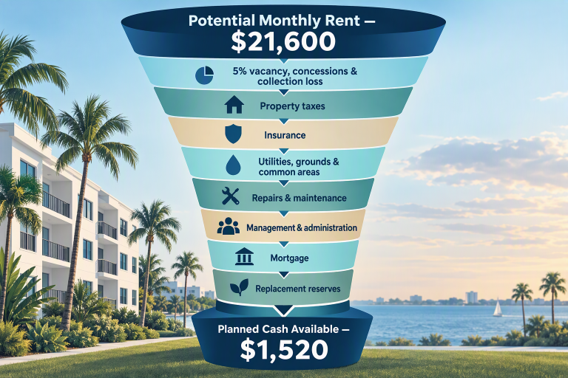
Here’s How $21,600 in Monthly Rent Can Leave Just $1,520
Let’s put the numbers together. This simplified example uses a 12-unit property with each unit renting for $1,800 per month and includes a 5% allowance for vacancy, concessions, and collection loss. These are hypothetical planning assumptions—not local averages, insurance estimates, or Pristine Bay management fees.
| Monthly budget item | Amount |
|---|---|
| Potential rent at full occupancy | $21,600 |
| Less vacancy, concessions, and collection-loss allowance | −$1,080 |
| Effective rental income | $20,520 |
| Property taxes | −$2,500 |
| Insurance | −$2,000 |
| Owner-paid utilities, grounds, and common areas | −$1,800 |
| Routine repairs and maintenance | −$1,200 |
| Management, leasing, accounting, and administration | −$1,500 |
| Net operating income before debt and replacement reserves | $11,520 |
| Mortgage principal and interest | −$8,500 |
| Planned contribution to replacement reserves | −$1,500 |
| Planned cash available after debt and reserve contribution | $1,520 |
At first glance, $21,600 in monthly rent sounds substantial. But in this example, $259,200 in potential annual rent leaves $18,240 after the modeled operating expenses, debt payments, and reserve contributions—before income taxes and any surprise costs beyond those allowances.
One quick distinction helps here: net operating income measures the property before financing and replacement reserves. The cash available to you comes after those commitments. And even then, one major repair can use the reserve and require more money out of pocket.
“I’ll Handle It Myself” Still Uses Something Valuable
Managing the property yourself can absolutely work, but your time still has value. When you compare that option with professional management, look beyond the headline fee. Review the full agreement—including ongoing, leasing, renewal, and maintenance-coordination fees—and consider the processes, reporting, and response support that come with them.
Ask practical questions: How are vacancies tracked? Who decides which repairs come first? How is spending approved? Can you easily separate routine costs from unusual ones? A management partner should help you understand what is happening and act on problems, but no arrangement can guarantee a profit.
Before You Buy—or Renew Another Lease—Pressure-Test the Budget
Before you decide, start with the last 12 months of actual income and expenses. If you are buying, ask for—and verify—the rent roll, leases, utility bills, maintenance history, operating records, and information about major replacements.
Then make the budget your own. Update taxes and insurance, identify deferred work, and ask what happens in a tougher year: collections dip, a unit takes longer to lease, expenses rise, or a major repair arrives. In Florida, that plan should also include storm communications, vendor contacts, property documentation, and a safe process for assessing damage afterward.
Is Your Rental Working as Hard as You Are?
If you own a rental home, duplex, or multifamily property in St. Petersburg, Pinellas County, or the surrounding Tampa Bay area, getting clear on the true operating costs can make your next decision much easier.
That is where Pristine Bay Investment Property Management can help. We provide residential and multifamily property management services for owners who are evaluating a purchase or taking a fresh look at a property they already own. Let’s talk about your property, your goals, and the kind of support that would make ownership work better for you.
Visit PristineBayGroup.com or call 727-896-7875 to start the conversation.
When you reach out, tell us the property location, number of units, and the ownership challenge taking the most time or attention. We’ll start there.
This article provides general educational information. Legal, tax, financing, and insurance decisions should be reviewed with the appropriate qualified professionals.
Your Florida Rental Owner Toolkit
Whether you are evaluating a purchase, reviewing insurance, responding to property damage, checking maintenance duties, or preparing for hurricane season, these official resources can help you take the next step. Start with the topic that matches the decision in front of you. Sources accessed October 4, 2026.
Choose your starting point: Buying or updating your budget? Begin with the property-tax tools. Reviewing your coverage? Open the hurricane and flood-insurance guidance. Handling water damage? Go to the EPA mold resource. Confirming maintenance duties? Review the Florida statute. Preparing for storm season? Use the hurricane-readiness guide.
1. Estimate Your Pinellas County Property Taxes and try the Property Tax Estimator before buying or revising your budget.
2. Review Hurricane Insurance and Recovery Guidance and read the Flood Insurance Overview to prepare questions for your insurance professional.
3. Learn How to Respond to Moisture and Mold with guidance from the U.S. Environmental Protection Agency.
4. Review Florida Landlord Maintenance Obligations in Section 83.51 of the Florida Statutes.
5. Build a Hurricane-Readiness Plan with resources from the Florida Division of Emergency Management.